Loading page…
All work
SaaS · Offline-First Healthcare
APHIA
Pharmacy POS, stock, and finance that keeps trading when the internet drops.
- Client
- APHIA — pharmacy management SaaS
- Industry
- Healthcare · Retail pharmacy · B2B SaaS
- Market
- French-language pharmacy market, with IPM mutual-insurance billing
- Our role
- Architecture, design, and full-stack development
- Timeline
- March 2026 — July 2026
- Year
- 2026
aphia.care
Next.js 16React 19TypeScriptMongoDBIndexedDBPWA
~71k
Lines of TypeScript
~290
Source files
82
Commits, Mar → Jul 2026
6
Core modules
6
Permission levels
4
Stage import wizard
The brief
What the project had to solve.
APHIA is a French-language, multi-tenant pharmacy management platform covering point of sale, inventory, and finance, built as an offline-first progressive web app. Roughly 71,000 lines of TypeScript across ~290 files and 82 commits. The defining constraint was not a feature list: pharmacies in the target market lose internet regularly, and a pharmacy that cannot sell is a pharmacy that is closed. Everything in the architecture follows from that.
The problem
Most retail software treats offline as an error state and shows a "you are offline" page. For a pharmacy that is unacceptable — checkout and stock reception are exactly the operations that cannot wait for a connection. The naive fix, replaying individual server actions from a queue, falls apart the moment a cart is edited several times offline: you end up reconciling a stream of conflicting mutations against server state you never saw. On top of that, the domain itself is unforgiving — mutual-insurance split billing, lot and expiry tracking, cash-register reconciliation, and six levels of role-based access over patient PII all have to stay correct across a sync boundary.
The approach
How it was built.
6 decisions that shaped the result — and why each one went the way it did.
Mirror-then-queue, not action replay
Rather than replaying every server action, any cart mutated while offline is mirrored into IndexedDB and becomes the local source of truth until checkout. The completed checkout — one coherent transaction, not a stream of edits — is pushed through a durable sync queue and finalised server-side with last-write-wins. Conflict surface collapses from "every mutation" to "one settled sale".
An offline shell that is actually the app
A dedicated offline route hydrates the POS and stock-reception screens entirely from IndexedDB caches of products, stock levels, IPM insurance data, and register sessions. Staff get the real working interface during an outage, not a degraded placeholder — which is the difference between an offline mode that is a feature and one that is an apology.
A smart importer for messy supplier spreadsheets
Suppliers send delivery notes as Excel files where the entire product description is crammed into one unstructured cell. The importer is a four-stage wizard — upload, map, review, commit — built on a rule-ordered label parser with per-field confidence scoring, fuzzy column auto-mapping, two-tier validation that separates blocking errors from warnings, auto-creation of unknown products, and draft resume from a separate IndexedDB store.
One domain path for manual and imported stock
Imports route through exactly the same domain code as manual reception. Stock history and the audit trail cannot diverge based on how the goods were entered — a property that is nearly impossible to retrofit and cheap to design in.
Domain logic isolated and unit-tested
Pricing, discounts, payment summaries, inventory variance, and SPPS pricing live as pure modules with node:test coverage, deliberately separated from the React and database layers. The rules that decide what a customer owes are testable without a browser or a database.
Permissions that reach the data, not just the menu
A six-level role system governs invitations, audit trails, login-attempt throttling, alert visibility, and access to patient PII — enforced at the data layer rather than by hiding navigation items.
Inside the product
6 modules, one system.
POS
Full checkout flow with IPM mutual-insurance split billing, cart discount rules, price overrides, barcode scanning, and receipt printing.
Stock
Delivery/BL reception, lot and expiry tracking, shelf management, a stock-movement audit log, and physical inventory sessions with variance reports.
Finance
Cash-register sessions (open, close, reconcile), receivables, expenses, invoicing, and analytics dashboards.
Alerts
A rule engine for low stock and expiring lots, with a cron runner and RBAC-scoped visibility.
Users
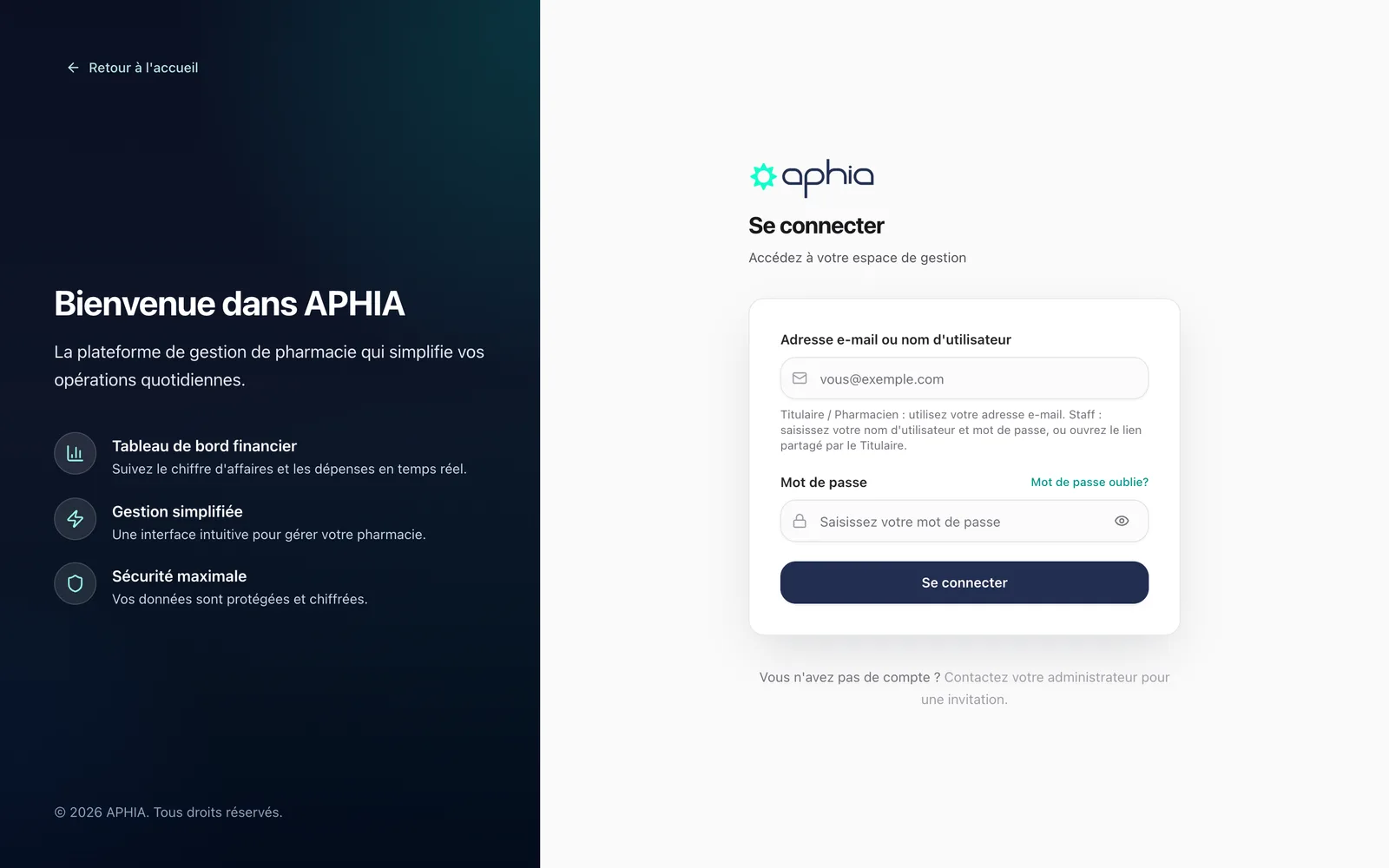
Six-level role-based permissions, invitations, audit trail, and login-attempt throttling.
Clients / Patients
Patient records with validation and RBAC-gated access to personally identifiable information.
What it does
Shipped features
- Offline-capable point of sale with barcode scanning and receipt printing
- IPM mutual-insurance split billing
- Cart discount rules and price overrides
- Delivery note (BL) reception with lot and expiry tracking
- Shelf management and stock-movement audit log
- Physical inventory sessions with variance reporting
- XLSX delivery-note importer with confidence-scored field parsing
- Draft resume for interrupted imports
- Cash-register sessions with open, close, and reconcile flows
- Receivables, expenses, and invoicing
- Financial analytics dashboards
- Rule engine for low-stock and expiry alerts, driven by a cron runner
- Six-level RBAC with invitations and audit trail
- Login-attempt throttling
- Patient records with RBAC-gated PII access
- Installable PWA with a custom offline shell
- Multi-tenant data isolation
- Excel export and print-ready documents
What it runs on
The stack
Application
- Next.js 16 (App Router, Server Actions)
- React 19
- TypeScript
Interface
- Tailwind CSS 4
- shadcn/ui (Radix primitives)
- Recharts
- react-hook-form + Zod
Data & offline
- MongoDB (multi-tenant)
- IndexedDB via idb
- Durable sync queue with last-write-wins finalisation
PWA
- @ducanh2912/next-pwa
- Service worker
- Custom offline shell route
Security
- jose JWT auth
- bcryptjs
- Six-level RBAC
Integrations & tooling
- Vercel Blob storage
- xlsx
- react-to-print
- node:test for domain unit tests
The result
What the build changed.
Point of sale and stock reception stay fully operational through internet outages — the shop keeps trading.
Conflict resolution reduced to one settled transaction per sale instead of a stream of replayed mutations.
Unstructured supplier spreadsheets become validated stock entries without manual re-keying.
Imported and manually received stock share one audit history, so records cannot diverge.
Pricing and inventory rules are unit-tested independently of the UI and database.
See it live
Let’s Work Together
Ready to build something fast?
Thirty minutes on what you need and what it would take. You leave with a clear recommendation either way.
Usually replies within a day · No obligation · Fixed-price quotes