Loading page…
All work
HealthTech · Marketplace
TrueDoc
Verified-doctor search and booking for Brazil, built by practising physicians.
- Client
- TrueDoc — founded and run by practising physicians
- Industry
- Healthcare · Two-sided marketplace
- Market
- Brazil — Brazilian Portuguese, LGPD data-protection regime
- Our role
- Design & front-end development — patient search, doctor onboarding, verification-led IA
- Timeline
- Shipped, in production
- Year
- 2025 — 2026
truedoc.com.br
ReactViteTypeScriptAWS S3 + CloudFrontGA4LGPD
5
Core routes: home, about, search, login, register
4
Filter dimensions incl. insurance and training
2
Sides served: patients and doctors
The brief
What the project had to solve.
TrueDoc connects Brazilian patients with verified doctors. The founders are physicians, and their stated mission is unusually sharp: the platform exists to fight medical misinformation. It only accepts doctors whose academic credentials check out and whose practice is grounded in evidence-based medicine — explicitly refusing listings from anyone who manipulates information or advertises with misleading claims. The product had to make that editorial stance visible in the interface, not buried in an about page.
The problem
Brazilian doctor-finder platforms compete on directory size, which quietly rewards volume over verification and lets misinformation-driven practitioners buy visibility. TrueDoc inverts the model — a smaller, verified network — which creates a positioning problem: to a patient, a directory with fewer doctors looks worse unless the reason is legible in the first three seconds. The second problem is supply. Doctors will not invest in a profile on a platform they have never heard of, so the recruitment path had to sell the mission before the signup form.
The approach
How it was built.
6 decisions that shaped the result — and why each one went the way it did.
Verification as the primary visual message
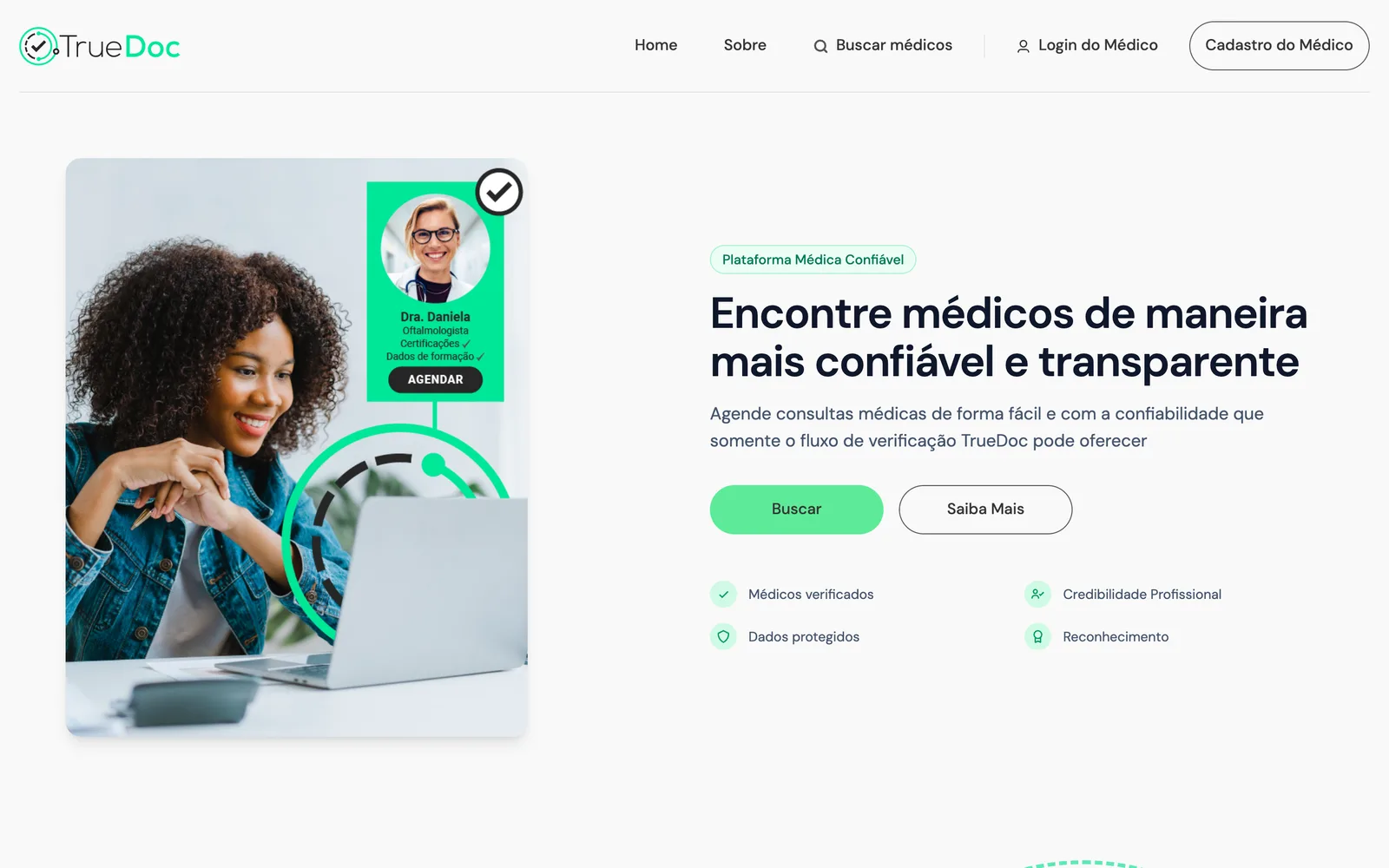
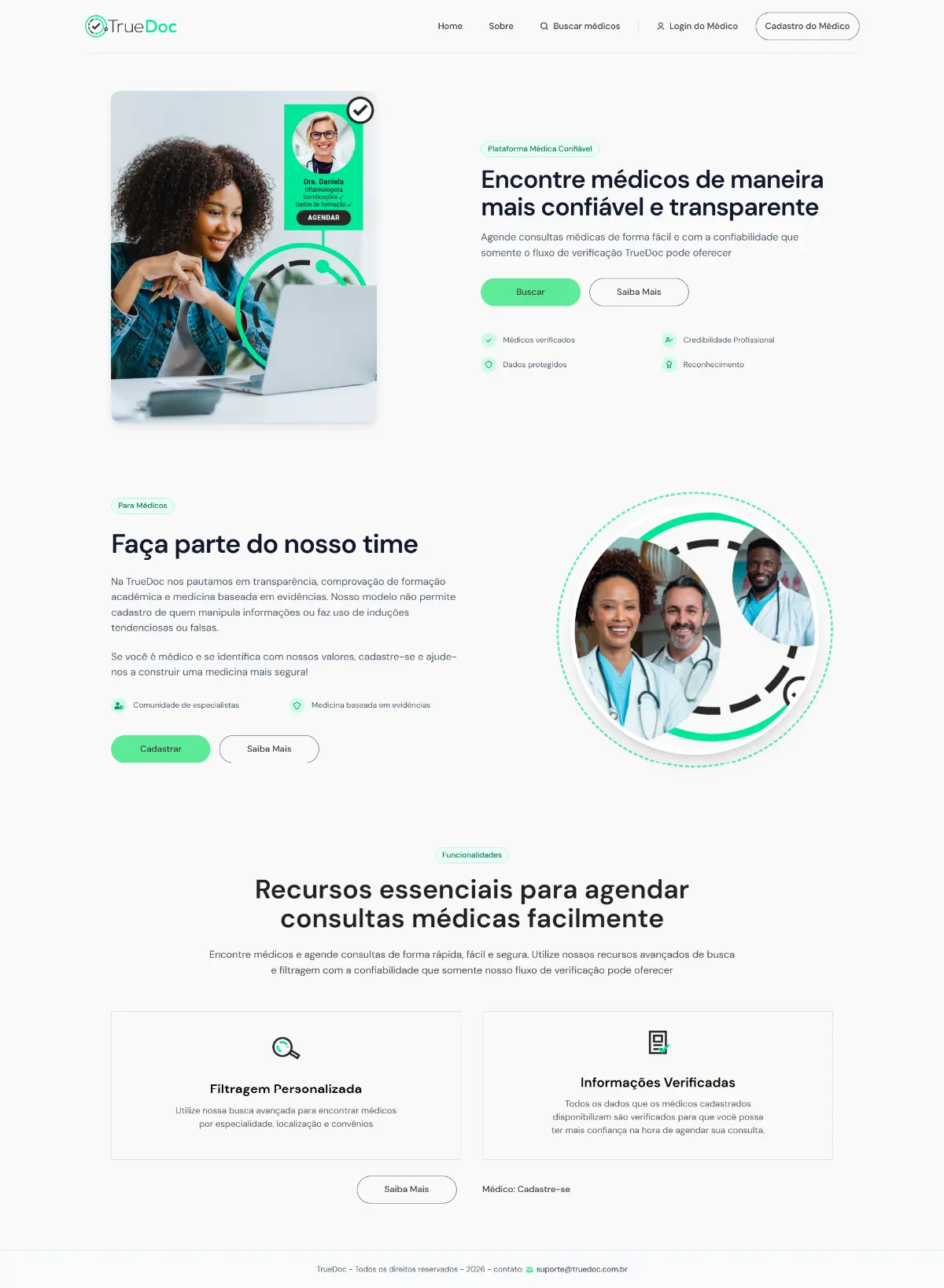
The hero pairs the promise — "find doctors in a more reliable and transparent way" — with an illustration of a doctor card carrying an explicit verification checkmark, certifications ticked, training data ticked. Four trust markers (verified doctors, professional credibility, protected data, recognition) sit directly under the calls to action. A patient understands the differentiator before scrolling.
Two audiences, two doors, one page
Patients and doctors want opposite things from the same homepage. Patients get search and reassurance; doctors get a dedicated "be part of our team" section that leads with values — transparency, verified academic training, evidence-based medicine — and states plainly who will not be accepted. Self-selection does the recruitment filtering before a single application is reviewed.
Search that mirrors how Brazilians actually pick a doctor
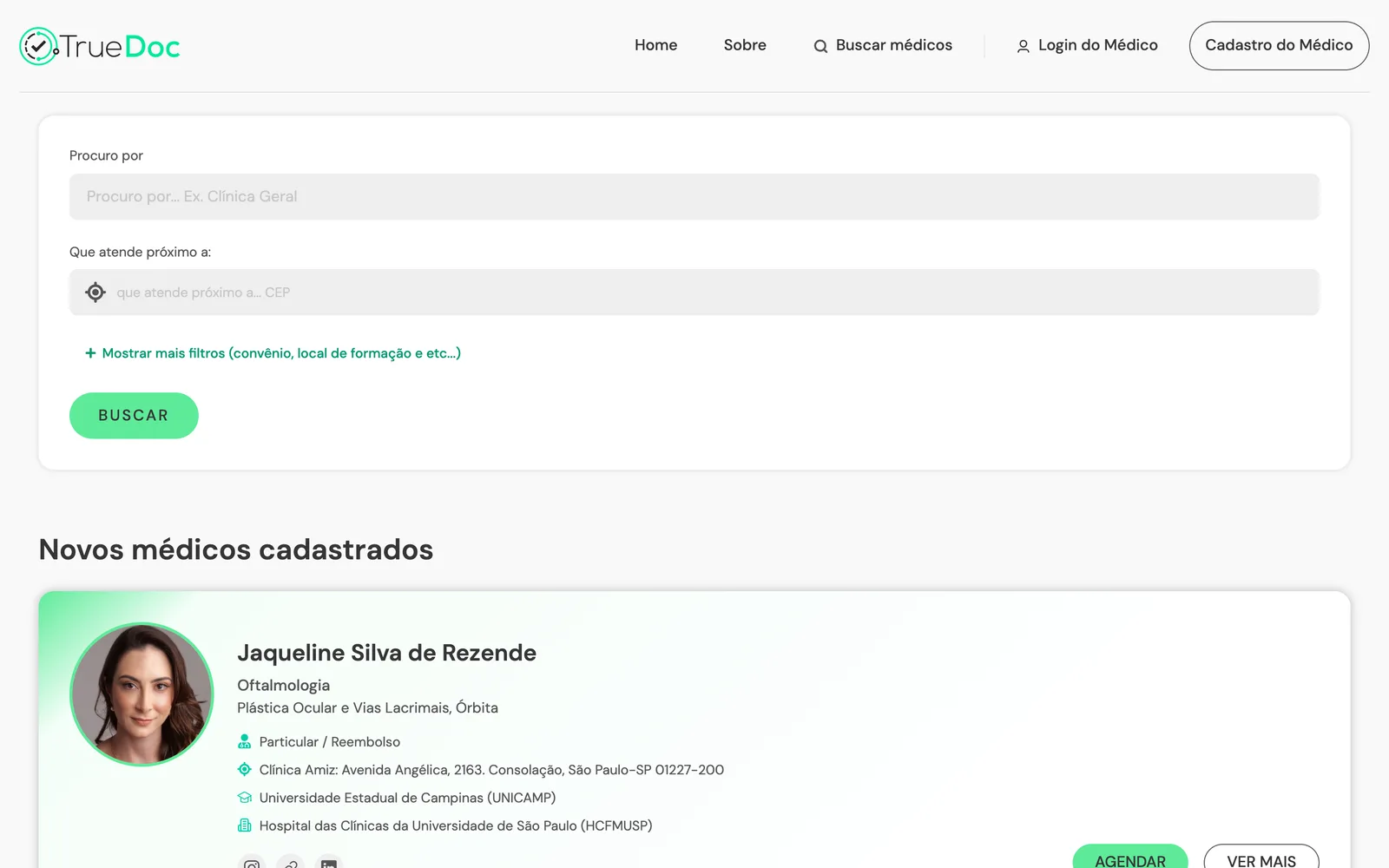
Filtering runs on specialty, proximity, and — critically for the Brazilian market — health-insurance acceptance (convênio) and where the doctor trained. Result cards surface subspecialty, payment model, full clinic address, medical school, and residency hospital, so the credential check the platform performs is visible on the card rather than hidden behind a profile click.
Booking as the shortest path
Every result card carries both AGENDAR (book) and VER MAIS (see more), so a patient who has already decided never has to open a profile page to act.
LGPD compliance built in, not bolted on
A consent banner governs analytics and browsing cookies under Brazil's LGPD with genuine accept and refuse options — a legal requirement in the market, and consistent with a brand whose entire pitch is trustworthiness.
Static delivery on a global edge
The app is a compiled single-page build served from object storage behind a CDN, so pages arrive fast across Brazil with no server to keep warm and no per-request cost as the directory grows.
The whole thing
Every screen, top to bottom.
These are complete page captures, not crops. Point at one to walk it from top to bottom — on a phone it plays as it comes into view.
truedoc.com.br
 Full page
Screens
A closer look at what shipped.
truedoc.com.br
What it does
Shipped features
- Advanced doctor search by specialty and proximity
- Extended filters: health insurance (convênio), place of training, and more
- Verified doctor profiles with subspecialty, medical school, and residency hospital
- Payment model shown per doctor (private / reimbursement)
- Full clinic address per listing
- Direct appointment booking from search results
- Newly registered doctors feed on the search page
- Separate doctor login and registration portals
- Credential verification workflow behind listings
- Mission and values page stating the editorial standard
- LGPD-compliant cookie consent with accept and refuse
- GA4 analytics
- Portuguese-language SEO metadata across all routes
What it runs on
The stack
Front end
- React
- Vite
- TypeScript
- Client-side routing
Delivery
- AWS S3 static hosting
- CloudFront CDN
- Brotli compression
- Long-lived edge cache with instant invalidation
Compliance & measurement
- LGPD cookie consent
- Google Analytics 4
The result
What the build changed.
Verification is legible in the first viewport, so a smaller network reads as a stronger one.
Doctor recruitment filters itself: the values section states who will not be accepted before the form appears.
Static edge delivery keeps the directory fast nationwide with no server cost curve as listings grow.
LGPD consent shipped from day one rather than retrofitted.
See it live
Let’s Work Together
Ready to build something fast?
Thirty minutes on what you need and what it would take. You leave with a clear recommendation either way.
Usually replies within a day · No obligation · Fixed-price quotes